
First, a tale of two headlines.
Tell me which would get you to click “buy”:
Sowing the seeds of tomorrow.
or
Fresh microgreens, delivered alive.
These are real headlines, and I’ll tell you where they come from in a minute.
For now, with no other context: Which one gets your order?
How you answer tells me about you. It tells how you see yourself and what you want out of a business interaction.
It shows me your self-interest.
And self-interest is the only thing that makes us buy.
WE’RE ALL OUT FOR OURSELVES
Not only ourselves. Sometimes, not even mainly ourselves.
But consistently ourselves.
You’re wired to do what makes you happy, keeps you safe and takes as little energy as possible. So am I.
We’re wired to survive.
And if we want to change our industries and make the world more just, we have to start with this truth.
Last week I wrote about a different truth: I told you how I ask what business owners hate about their industries, and how their answers always show they want the world to be more right or fair or equal.
They want justice.
We all do. We see the status quo is hurting people, and we want to fix it.
So… why don’t we?
Why do industries stay broken?
Because we want other things as well – like personal safety, happiness and ease. We want survival. We want comfort. We want to take care of us.
That’s good, too.
But sometimes these instincts clash. Sometimes my easy is the planet’s hard. Sometimes what helps my people doesn’t help all people.
Sometimes being out for yourself means hurting others.
When that happens – and it will – you’ll have to make a hard choice. Work you’ve done on your own character will inform that choice.
But work you’re doing on your business? That’s about something different.
With your business, you can make a world where people aren’t faced with that choice in the first place.
HIDE THE CANDY
After Halloween, our house was full of it.
Where did we put the candy?
NOT in the 3-year-old’s room. Not even in her line of sight – because if she sees that big bag of candy, she will have to choose:
Should I save that for snack-time like my parents want?
or
Should I shove it all into my pie-hole now?
I want my daughter to learn to make good choices. But mostly, in this particular instance, I just want her to not eat the candy. No tantrums, no drama and no sugar crash.
That’s much more likely if she doesn’t have to make the choice at all.
A lot of things work this way: If you’re prediabetic, you don’t fill the pantry up with cookies. If you’re quitting beer, maybe skip Oktoberfest. If you want to cut back on screentime before bed, you charge your phone outside the bedroom.
If you want good behavior, make it easier to behave well. Engineer a life where good behavior gets you comfort, safety and simplicity. Line up your self-interest with your nobler goals.
If the right thing’s easy and the wrong thing’s hard, you’ll do the right thing often.
If the wrong thing’s easy and the right thing’s hard – you probably won’t.
If that’s true of us all, then we can make our world a better world in two ways: When the river of self-interest flows away from justice, we can swim against it. We can try to make the good choice even when it hurts and ask society to do the same.
Or we can reverse the current.
Business is a chance to do the second one.
FIRST, REDEFINE WHAT’S PROFITABLE
If you’re angry that your industry is full of privileged bros who treat their clients like dirt, you can spend all day complaining about male privilege.
If you’re upset by how private equity’s buying up your industry and making customer service less humane, you can post on LinkedIn about how P.E.’s the devil.
If you’re bummed that more people don’t buy solar panels, you can criticize them for not caring about our children’s future.
Good luck with all that.
It won’t work – because you’re not a superhero punching bad guys. You’re a business.
So are your competitors, out there doing things you feel are wrong or ineffective or unfair. They act the way they do because it works.
The thing you think is wrong makes someone safe and happy.
Or it’s easy.
It you want to change the status quo, change that.
Show privilege that empowering clients is good business. Show private equity that relational service retains customers and grows profit better than impersonal service. Change the economics of green energy.
If you want your industry to change, being upset about what it does wrong is a good start. It’s a good sign.
But it’s not a good strategy.
If you want to change your industry, offer a better way – and clearly show it’s better.
Not just nicer.
Better.
Do that, and the current of self-interest flows the way you want. The right way becomes the profitable way – so everybody wants it.
Easier said than done. Because to line up what is right with what is profitable, you’ll have to show it can win customers.
Which means understanding their self-interest, too.
Which brings us back to microgreens.
YOU CHOSE THE SECOND HEADLINE
I already know you did – because the second headline is the only one that makes it clear what’s even being sold.
Fresh microgreens.
I didn’t know what those were; you might not have either. But if you were in the buying audience for Keith Rowan’s business, Sowing the Seeds of Tomorrow, you would know.
Keith came to a Group Clarity call a few months back; he had just built a website for his new nonprofit and was looking for input. I’m sharing this with Keith’s permission.
Here’s what his homepage said then:
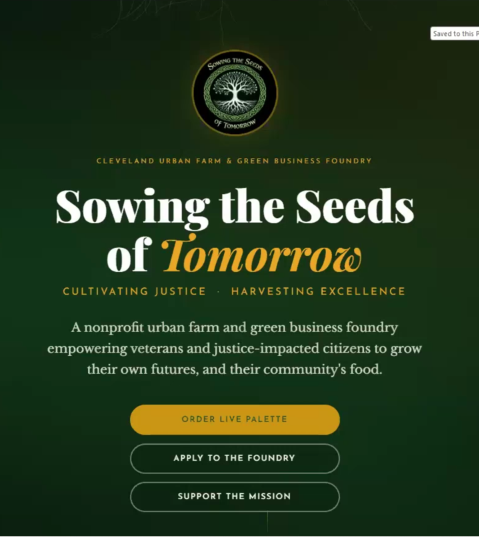
Like many purpose-driven founders, Keith has lots of audiences: Veterans, donors, chefs, communities. Lots of people to convince.
His first draft did what many organizations do: It messaged values. Justice, impact, and community. Empowering veterans.
This is a nice company. You would let your daughter date this company.
But you wouldn’t buy from them.
How could you? What would such a purchase even get you?
Would it get you safer?
Happier?
More at ease?
If that’s not clear – why are you reaching for your wallet?
BETTER BEATS NICER
I gave Keith my kneejerk instinct on that group call: Pick one audience. Name the group that you most need to give you money. Make the message about them.
Say why a purchase makes them safer, happier, easier.
Don’t say why you’re nicer. Tell them why you’re better.
One week later, Keith sent this:
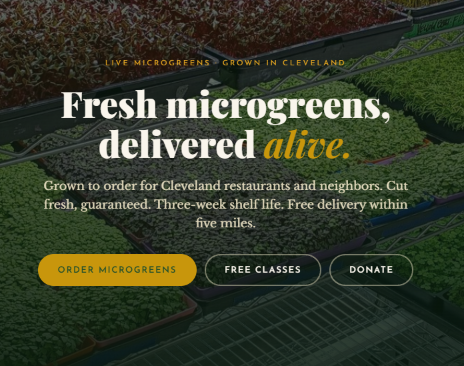
Yes, chef.
If I’m a restaurant buyer, I know why I’d pay him now. I can say why it’s easy, why it’s safe and why it makes me happy.
None of that stuff is Keith’s purpose. He’s out here to fix what’s wrong with local food and make society treat our veterans and our formerly incarcerated neighbors better; that’s the worthy change he wants to see.
But if he wants to see it, then he’s got to sell some greens.
His buyer’s self-interest is what gets that done.
BETTER IS HARDER
I don’t know why justice-oriented companies miss this, but we do.
We think “the right thing” is a business model. We think values are a value proposition. We think customers will buy and competitors will emulate us just because we’re nicer.
Nope.
You have to show you’re better.
If that’s what your company wants, I’d love to hear about it. I’d love to support you.
Book a call. I’ll tell you If your marketing’s making you look better – or just nicer.
