
In 2014, electric cars were less than 1% of U.S. vehicle sales.
Nine years later, they had 9% of the market.
That leap’s more than a number. It’s a change in how we think about our transport, what we picture when we hear the word “car” and how we decide what might be in our own garages next.
It’s a shift in collective imagination.
When that number changed, it changed what’s possible. But it didn’t change because consumers worried about peak oil. Three ghosts didn’t visit GM’s chair and show her how carbon emissions might kill Tiny Tim.
Moral conviction didn’t move those numbers – at least, not alone.
What did?
Suddenly, EVs became profitable.
And when you change what’s profitable, you change what’s possible.
Many of you would like to do that in an industry you love. You’ve noticed something’s not right, and you want to fix it.
But what happens if you do?
To see how magical and messy it can be to change an industry, let’s look at why gas cars – unchallenged for 100 years – finally started to lose market share to battery-powered cars.
One company was at the center.
You know who.
BOTH PAIN AND PROMISE
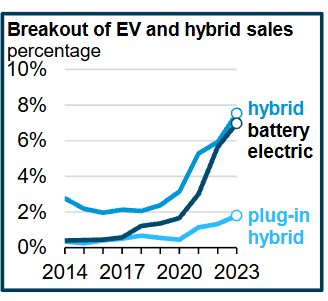
Look at this graph from EIA. Anything grab you?
Here’s another. Do you see it now?
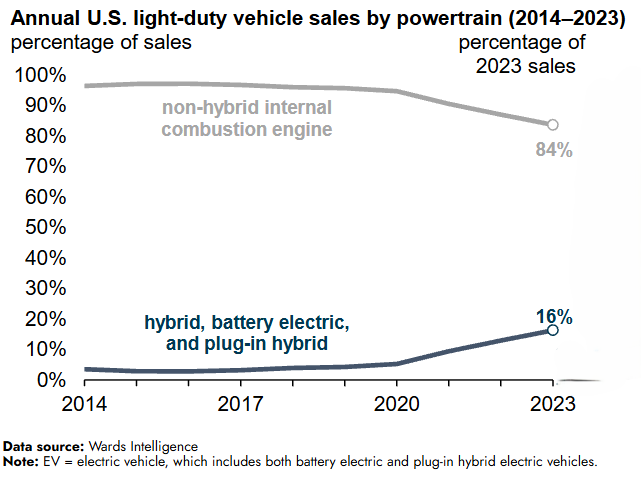
If you’re like me, you want to know what happened in 2020.
Battery electrics spiked in sales after that year – and kept on spiking. Hybrids, too.
What happened?
Two things:
New regulations punished companies that didn’t make EVs.
Some U.S. states were already saying automakers had to sell a certain number of EVs or else pay fines.
Europe had a similar rule — but its requirements got much tighter in 2020. China made its rule in 2018.
Tesla stock exploded.
The company’s stock price jumped 700% in one year.
Investors wanted to buy them. Competitors wanted to be them.
Since Henry Ford, U.S. car companies had been largely focused on gas vehicles – and for good reason. Cars cost tons to make and profit per vehicle is low, so you have to make a lot and sell a lot.
Making a lot of cars is the problem Ford solved in the 1910s, and he solved it for gas cars. The GMs, Fords and Chryslers of the world are optimized to make them.
EVs are different. Changing the product meant changing all those manufacturing processes.
It would hurt, and it would be a risk. So industry titans mostly didn’t do it.
Until 2020.
Then the math changed:
Global regulations made it hurt to NOT build EVs.
Tesla’s stock surge made building them not look like a risk.
For a long time, electric vehicles have been the “nice” choice.
In 2020, the market decided they were the better one.
This was Tesla’s purpose.
In 2006, Elon Musk wrote that the point of Tesla was to “expedite the move” from carbon-based fuels to solar power. In 2020, that move took a major leap.
But did they actually cause the leap?
Did Tesla architect this shift, or were they just in the right place at the right time to profit from it?
Yes.
IN THE RIGHT PLACE, WAITING FOR THE RIGHT TIME
Let’s look at the position Tesla chose in its own market.
They were a new company, making only EVs – something the established automakers struggled to do.
When regulations hit, this gave them an advantage: In the U.S., companies that didn’t make enough EVs could avoid fines by buying credits from the companies that did. Chinese and European regulations were a little different, but the regulations all led to the same result:
➡️ Competitors who didn’t make EVs wound up paying Tesla.
That’s one reason Tesla, after losing money for most of its existence, suddenly showed consistent profits. That’s one reason its stock prices shot up.
Here’s the other:
➡️ Investors saw Tesla as a tech company, not an auto company.
Tesla had acted like a Silicon Valley firm, not a Detroit-based automaker. They wrote software and updated cars after purchase. They sold direct to customers and ran their own stores (like Apple does!) instead of using dealerships. They focused on rapid growth. They did no paid ads, but a lot of PR.
These weren’t only business-model choices; they were positioning choices.
This was Tesla choosing how it wanted to be seen by buyers and by investors.
This was marketing.
Tesla’s position (2020)
Category: Auto maker
Differentiator: …that works like a tech company
Leading up to 2020, Tesla started explicitly talking about itself as a company that had moved beyond cars. It promised robotaxis and acquired a solar power business. Musk wrote about “turning the factory into a product.” Cars weren’t just a thing you drove; they were a platform. They were a launch pad to expand into everything else.
Tesla chose this, and then took action on it, and then said it.
And investors bought it.
And the crazy part about this market position is… it wasn’t even Tesla’s first.
ANOTHER TIME, ANOTHER PLACE
In 2006, when Musk first proclaimed Tesla would drive the move from carbon-based to electric, Tesla’s strategy was different.
He was an investor then, but not yet CEO. The company had just announced its very first car, the Roadster.
How?
It held a fancy launch with rich celebrities, showed an early car and took pre-orders for $100,000 deposits. The Roadster was a sportscar. It sold for a lot and wound up costing even more to make, which means for years Tesla lost money every time it made a sale.
Not great.
But they weren’t trying to turn a profit so much as claim a position in the market.
Tesla’s position (2006)
Category: luxury sports car
Differentiator: …that’s faster than a Porsche and greener than a Prius
In 2020, Tesla was in the tech business. In 2006, they were in the car business.
The explicit plan was: Make a sports car; use it to get money. Use that money to make more affordable cars.
That was the first playbook. That was how they’d win: By showing that EVs could be fun, fast and cool.
The strategy never turned a profit. But it got the company boatloads of attention, more than a hundred million in investments, several hundred millions in government loans and – eventually – an IPO that brought more cash in and let them keep growing, profitability be damned, until the whole thing finally turned around in 2020.
The sports-car strategy let Tesla reach the tech-company strategy.
I am not convinced that was the plan. But that’s what happened.
And the takeaway for me is: Times change. You can, too.
How do you change an industry? You find a way to offer something better, not just nicer.
Then you do it again, if need be.
And again.
Pick your position. Stand in what you think is your right place – and wait for your right time.
You probably can’t be the lighting.
Be the rod.
WHO GETS THE CREDIT?
As a marketer, I’m supposed to tell you that you have the power. Follow Tesla’s plan – or even better, Benjie’s! – and you’ll change your market. Everything will rock.
It’s not so simple.
Tesla made some clever choices – probably some dumb ones, too. And then a lot of things took place in global markets and in governments that Tesla couldn’t control.
The world just shifted.
At the right time, they were in the right position.
Companies can’t control the markets and they can’t control the government. (Elon Musk keeps trying. Success has its risks too; one of those is that you turn into a monster.)
Companies can’t control it all.
But they control themselves. They choose their own position: They choose how they’ll run and what they’ll say, and those things change what people think of them.
If people think you’re better, then what didn’t work once might work now. You might just change what’s profitable.
And that changes everything.
If this resonated, hit reply and tell me why.
If you’re thinking about your own position in your market, tell me about it.
